
How are our glaciers doing?
Every quarter, the subject manager at Norwegian Glacier Museum measurements of the front position of several glaciers in and around Jostedalsbreen National Park. The measurements document how the glacier fronts change over time, and give us important knowledge about the development of the glaciers in the face of a changing climate.
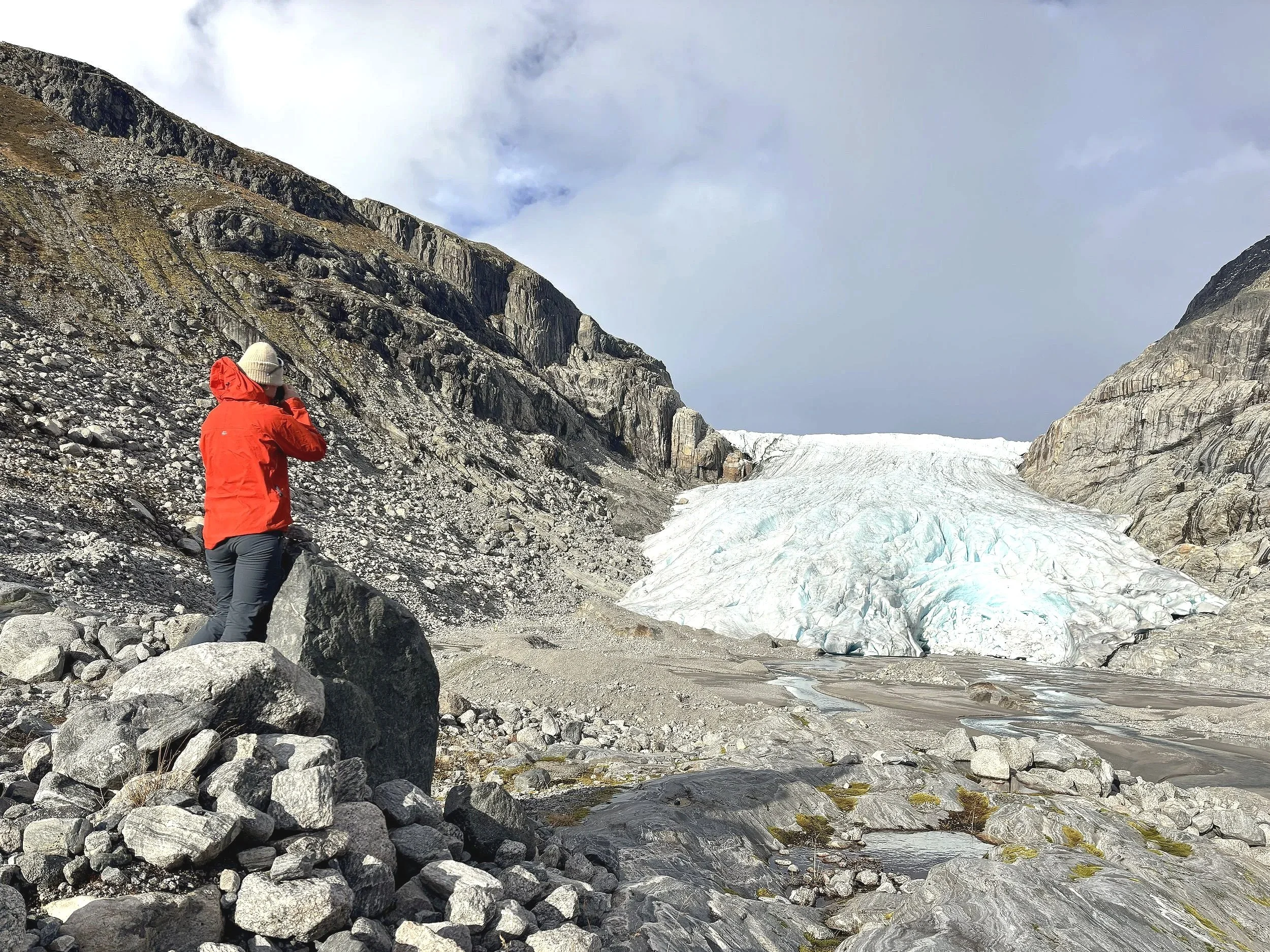
This is what Haugabreen looks like on October 24, 2026, from a height of a few hundred meters in front of the glacier. Here, the specialist is measuring Haugabreen with laser binoculars (Photo: Jorun Bækken).
One of the glaciers the museum follows is Haugabreen in Stardalen. Professional responsible at Norwegian Glacier Museum has measured the front position of Haugabreen glacier annually since 2013. The measurements show that the glacier has retreated almost 200 meters during this period.
An easily accessible glacier
Haugabreen is located in Stardalen in Jølster and is part of the Myklebustbreen, which in turn is part of the Jostedalsbreen. The glacier lies within the Jostedalsbreen National Park and is one of the glacier arms in Western Norway that is relatively easily accessible on foot.
The path up to the viewpoint at Haugabreen is widely used by hikers and people who want to experience the glacier up close. The path is marked and guarded, and from the viewpoint you can see the glacier and the surrounding landscape.
You can find more information about the trip at UT.no – Hike to the viewpoint at Haugabreen .
Why do we measure the glacier front?
Glaciers are constantly changing. How they develop depends, among other things, on temperature and precipitation. In winter, the glacier gains mass through snowfall, while in summer it loses mass as snow and ice melt. For the glacier to remain stable or grow, the supply of snow over time must outweigh the loss through melting and other processes.
When a glacier loses more mass than it gains over time, it will often retreat. If it gains more mass than it loses, the glacier front can advance. Changes in the glacier front can therefore tell us something about how the glacier is developing, and how it is responding to climate.
By measuring the front position year after year, we can document how far the glacier is moving. The measurements provide us with an important basis for following the development over time. At the same time, it is important to remember that the front position alone does not tell the whole story of the glacier. To get a more complete picture of the development, we also need to look at changes in the mass balance, i.e. how much mass the glacier gains and loses throughout the year.
Haugabreen glacier continues to retreat
This year's measurements show that Haugabreen has retreated about 50 meters since the previous measurement. If we look at the entire period from 2013, the glacier front has retreated almost 200 meters. The measurements document a clear change in the location of the glacier front. By continuing with the measurements year after year, Norwegian Glacier Museum Follow the development of Haugabreen and compare results over time.
Measuring glacier fronts is a way to make climate change visible in the landscape. The figures show how the glacier changes from year to year, while the long-term measurement series give us a better basis for understanding the development over time. This year's front position measurements were carried out by Solveig Farmen Aabø, specialist at Norwegian Glacier Museum Geologist Jorun Bækken was also on the trip.
« In total, the front position of Haugabreen has receded almost 200 meters since 2013 »
A few days earlier, the front position of the Marabreen glacier was measured. This glacier is an offshoot of the Jostedalsbreen glacier that must be crossed on the traditional traffic route between Lunde in Jølster and Bøyadalen in Fjærland . Norwegian Glacier Museum established a new fixed mark for front position measurements in 2024, but measurement difficulties due to a lot of broken ice made it challenging to measure the glacier front accurately. But what can be said is that the Mara glacier has also decreased since 2024. Something that was not very surprising after a warm melting season this summer.
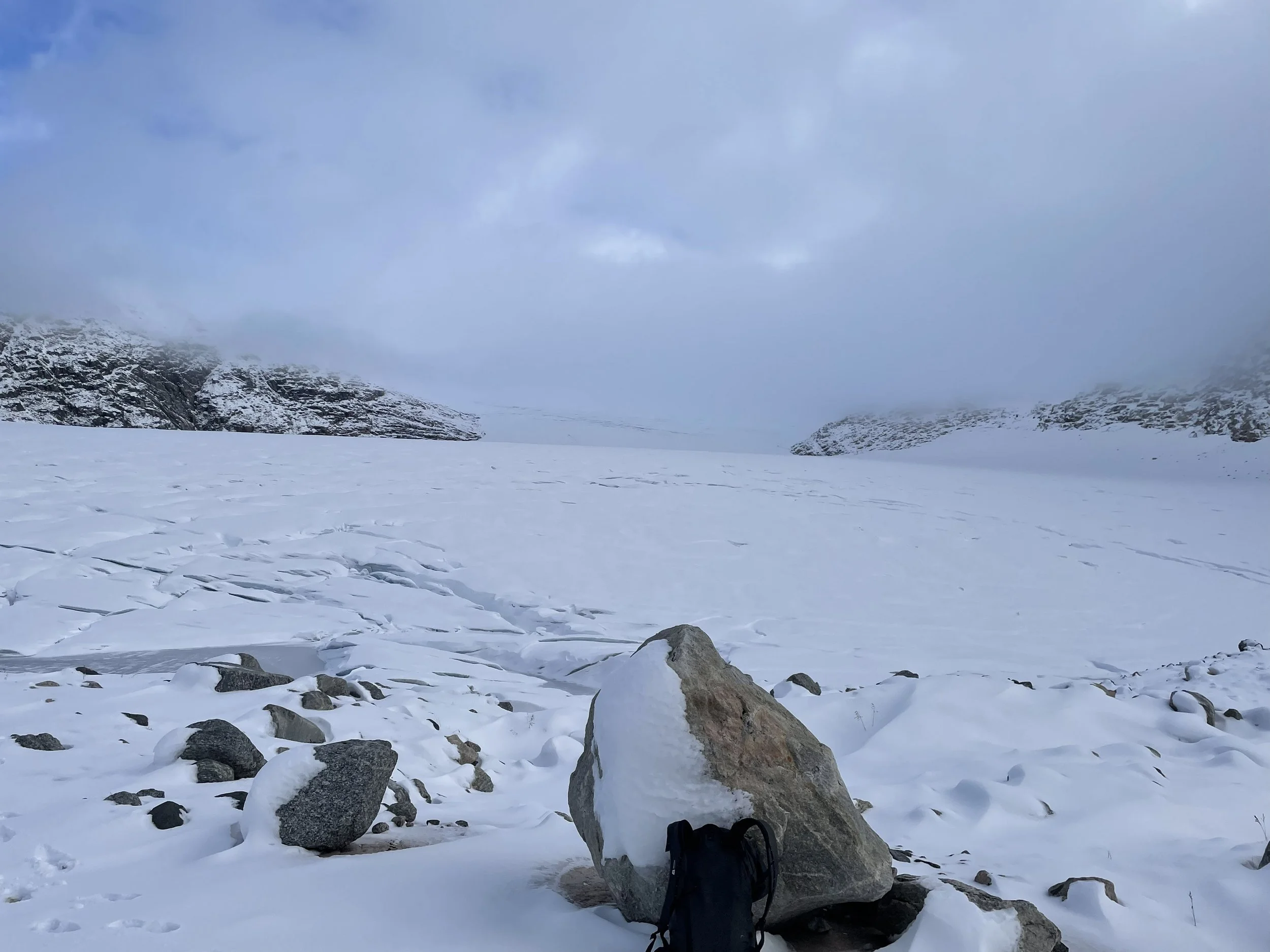
The Marabreen in a new coat of snow in early October 2026. (Photo: Solveig Farmen Aabø, Norwegian Glacier Museum ).
The results from the measurements are reported to NVE (Norwegian Water Resources and Energy Directorate).
